My Talk with the Editorial Freelance Association
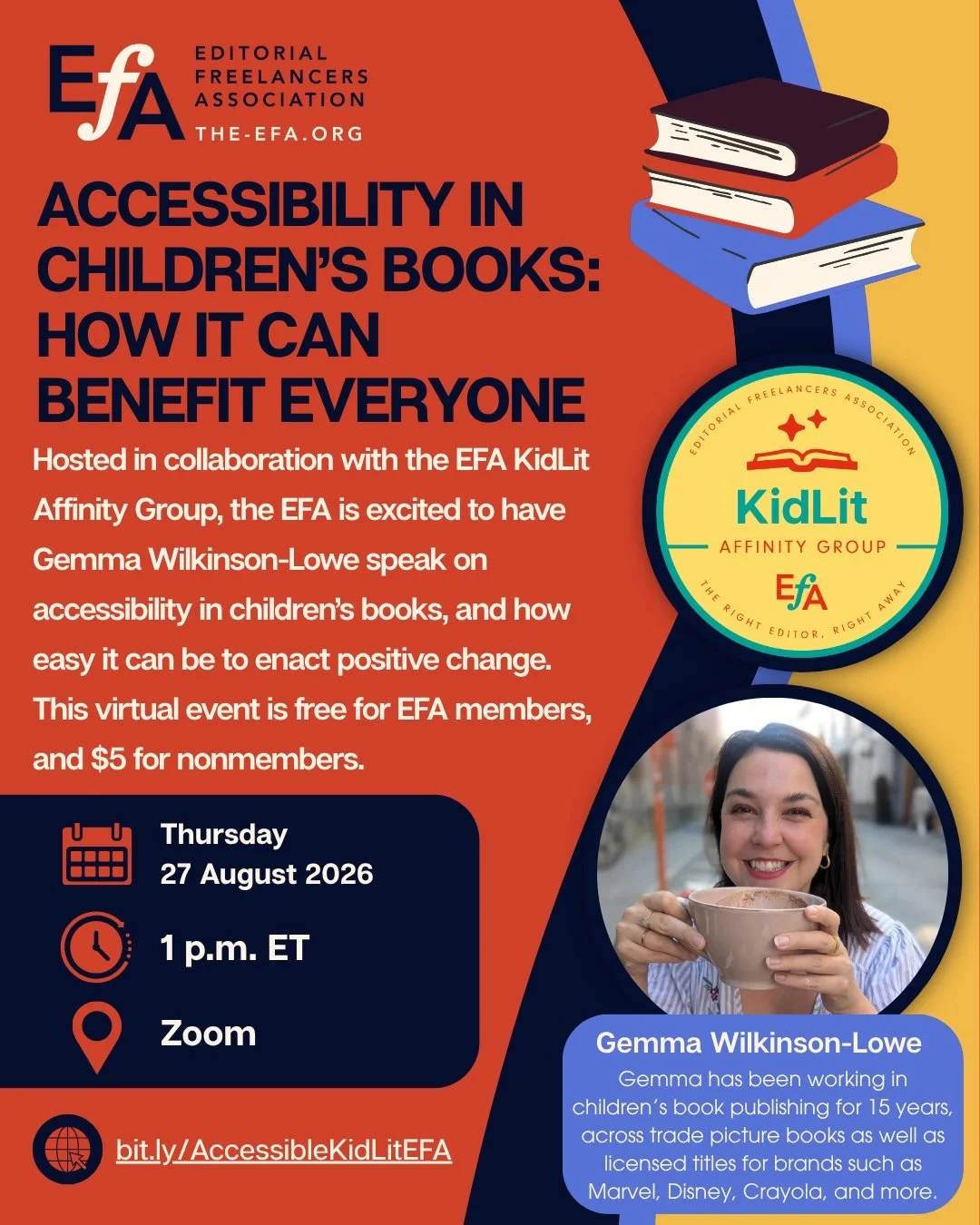
Last Thursday, I did my first talk about accessibility for the Editorial Freelance Association, ‘Accessibility in Picture Books: How It Can Benefit Everyone’.
I was filled to the brim with excitement, optimism and motivation about giving this talk. My goal in talking, blogging and writing about accessibility in the first place has been to raise awareness amongst other editors and publishing professionals. In the beginning, I set myself the goal of telling one other person who worked within the publishing industry, hoping it would snowball from there.
So imagine my utter delight when I was offered the opportunity to speak to the KidLit Affinity Group about accessibility. Apparently my website (this very one) had been passed around between the members – I had made it across the pond! I had thought my only audience were family members.
The talk itself went really well, I enjoyed myself, I got some fantastic feedback and was treated to an engaged and thoughtful question session at the end. The Q&A section was the part I was looking most forward to actually, as if someone asks you a question, that’s when you know they have engaged and processed the material. I felt quite proud of myself for trying something new, and I always relish opportunities to do and learn something new.
Here are a few things I learned about giving my first talk:
1) Practise, practise, practise!
“Write a script, read through it, record yourself reading it, practise it in the room you’ll be giving the talk,” my partner, Nick, told me many times when I was planning for the talk.
He was right and I have thanked him for his brilliance.
I went into this talk prepared enough for my talking points that I didn’t overrun and I was comfortable enough to ad-lib and add anecdotes so I wasn’t just reading a script on the day.
2) Writing for Speech
Reading through my speech out loud and listening to myself in real time and on video, helped me to edit it to sound like the spoken word, rather than the written style of my blog posts and style guides.
I am used to a style of writing that is composed to be read and as such it does not have the flow of the spoken word for a talk to a large group. I tweaked the language to fit with how I naturally read each sentence, and it helped everything feel much smoother.
3) Timing
I timed each part of my speech on a few run-throughs. I am, by nature, a hyperbolic person who says fifteen words when two or three will do. Especially if I am talking about something I am passionate about, I can, and will, talk about it for as long as possible, and in as much detail as possible. Because I know the details and BOY, I am just excited that you want to hear those details as well.
So a big fear of mine was that I would get carried away and waffle. I have no fear about speaking for a long time, my fear is that I can. This subject and this moment was far too important to me for me not to go in and be precise, interesting and clear about my main message. Giving myself a specific time for each section and knowing I could read through at a good pace in that time gave me confidence.
4) Pauses
This was another tip from my MVP, Nick. I wrote [pause] in natural parts of the sentence and after I had made each point, so people could have a moment to process what had just been said.
This helped to remind myself to pause, pace and slow down while I was talking about a subject I am excited about, which is necessary. He also told me to pause for a second longer than felt natural to me as well, though I am not entirely sure if I did this in the moment, it is something I will try and bring through to my next talk.
5) Nerves and Confidence
I was really nervous before the talk, which is normal, but I am not usually the type of person who gets very nervous so I think I was a little surprised at myself.
The final run-through I had done that afternoon went terribly for some reason. I felt lacking in energy and I barely believed that I knew what I was talking about. Imposter syndrome crept in, I think, as I got closer to the moment, I started to worry that this was the moment people would call me out for not knowing what I was talking about, stating the obvious, saying nothing new or interesting.
Intellectually, I know this is the not the case, that all the people who had signed onto my talk wanted to hear what I had to say, where interested, and that I was well-researched, detailed and passionate about this subject. Like Lewis Hamilton, I remembered who the hell I was, took a sip of water and dialled in. Luckily, everyone was so welcoming and excited on the call, I felt comfortable and at ease immediately.
And there you have it. My first talk done. Successfully. The first of many, I hope.